

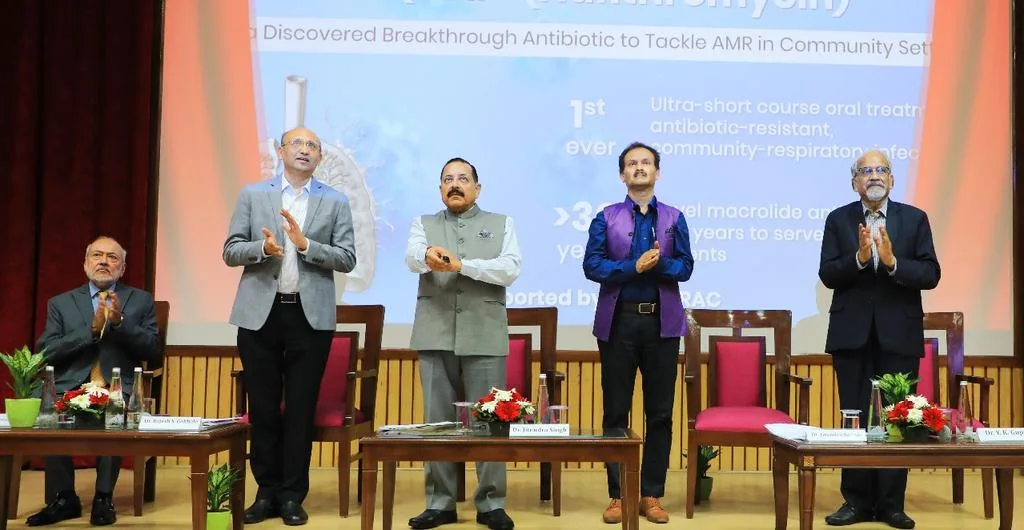
NEW DELHI, Nov 21: In a groundbreaking development for India’s biotechnology sector, Union Minister of Science and Technology, Dr. Jitendra Singh, on Wednesday announced the soft launch of Nafithromycin, the country’s first indigenous antibiotic designed to combat drug-resistant infections. This antibiotic marks a significant milestone in the fight against antimicrobial resistance (AMR), a growing global health crisis.
Dr. Singh, speaking at the event, emphasized that the launch of Nafithromycin was made possible due to the supportive environment created after 2014 when Prime Minister Narendra Modi’s leadership and personal intervention gave researchers the necessary resources to explore their potential. The development of Nafithromycin was backed by the Biotechnology Industry Research Assistance Council (BIRAC), a unit of the Department of Biotechnology, and was brought to market by pharmaceutical company Wockhardt under the trade name Miqnaf.
Nafithromycin is specifically aimed at tackling Community-Acquired Bacterial Pneumonia (CABP), a severe infection caused by drug-resistant bacteria. Pneumonia, particularly drug-resistant strains, is responsible for over two million deaths globally each year, with India bearing 23% of the world’s pneumonia burden. Nafithromycin’s introduction offers a revolutionary solution to a condition that has long been resistant to common antibiotics like azithromycin. The new drug is ten times more effective than existing treatments, with a shorter, three-day regimen that is also safer and more tolerable for patients.
The antibiotic’s remarkable efficacy lies in its ability to target both typical and atypical pathogens, offering a potent remedy in a class where no new drugs have been developed in over three decades. Clinical trials have validated its effectiveness, demonstrating that Nafithromycin achieves superior results with minimal gastrointestinal side effects and no significant drug interactions, making it a versatile and patient-friendly option.
Dr. Singh noted that the launch of Nafithromycin represents 14 years of dedicated research, an investment of ₹500 crore, and clinical trials conducted in the U.S., Europe, and India. The drug has been developed with the support of BIRAC under its Biotechnology Industry Partnership Program (BIPP), showcasing the power of public-private collaboration in driving healthcare innovation. The antibiotic is currently awaiting final approval from the Central Drugs Standard Control Organization (CDSCO) for mass manufacturing and distribution.
Highlighting the growing concern over AMR, Dr. Singh stated that antimicrobial resistance prolongs illnesses, increases healthcare costs, and undermines medical advances. He called for continued investment in AMR research and innovation, particularly in developing new antibiotics and diagnostic tools. He also pointed out that the COVID-19 pandemic had amplified global awareness of the importance of biotechnology in addressing health crises, urging the scientific community to harness this momentum to tackle AMR.
The launch event, held during World AMR Awareness Week, brought together leaders from the scientific and pharmaceutical communities, including Dr. Rajesh S. Gokhale, Secretary of DBT and Chairman of BIRAC; Dr. Habil Khorakiwala, Chairman of Wockhardt; Dr. Jitendra Kumar, MD of BIRAC; and Dr. Y.K. Gupta, President of AIIMS Jammu.
Dr. Singh concluded by reaffirming India’s commitment to addressing AMR and improving global public health. “Nafithromycin is a beacon of hope in our fight against drug-resistant infections, and its development exemplifies India’s growing capabilities in biotechnology and pharmaceuticals,” he said.
