

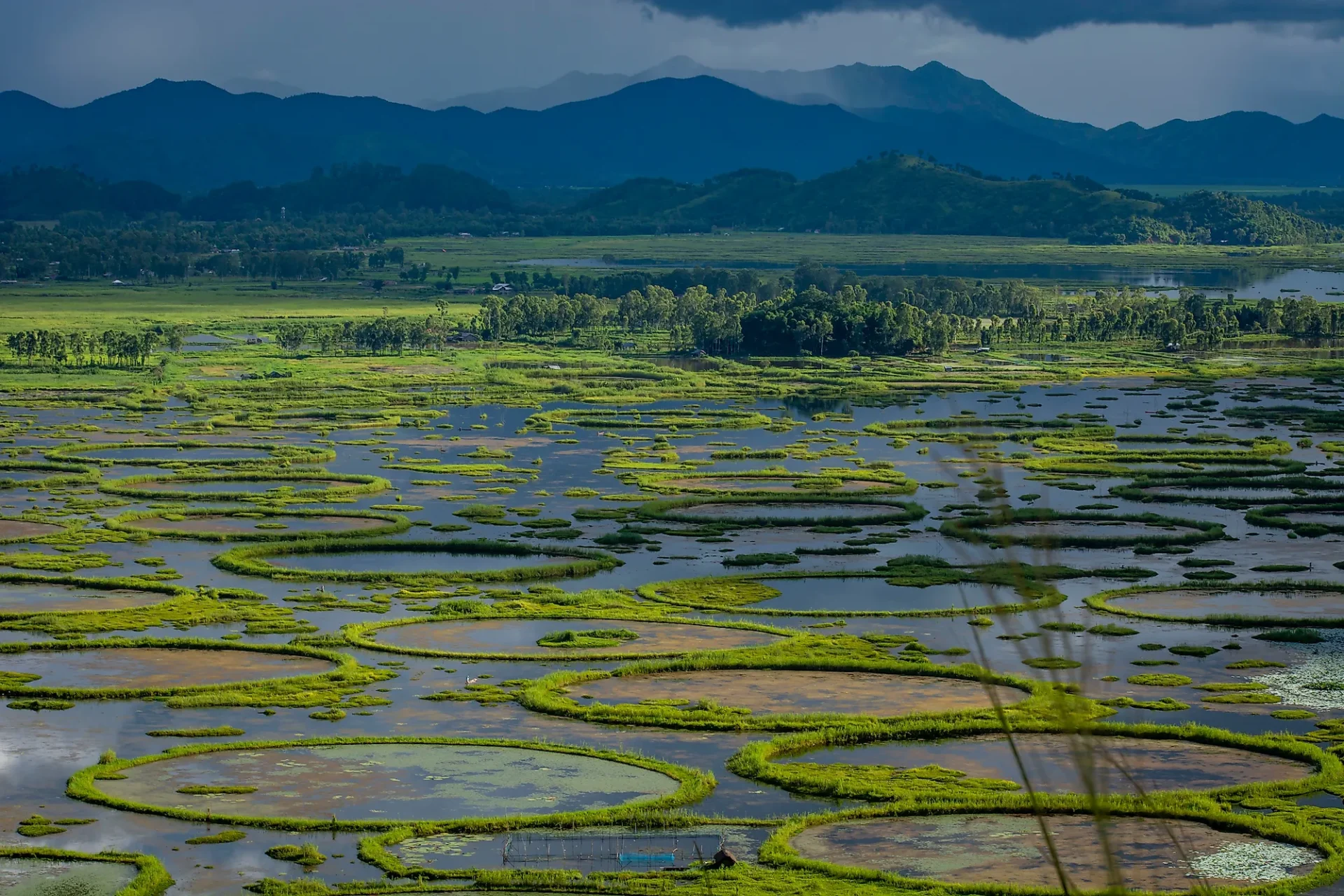
IMPHAL, Oct 27: A recent study conducted by Nagaland University has raised serious concerns about the worsening pollution levels in Loktak Lake, Manipur’s iconic freshwater ecosystem and a designated Ramsar Site. The research reveals that uncontrolled agricultural expansion, human settlements, and shifting (Jhum) cultivation in the catchment areas are severely degrading the water quality of rivers feeding into the lake, particularly the Nambul and Khuga rivers.
Led by Dr. Eliza Khwairakpam, Assistant Professor in the Department of Environmental Science at Nagaland University, the study was published in the International Journal of Environment and Pollution. It analysed the impact of land-use patterns—agriculture, forests, settlements, and Jhum cultivation—on key water quality parameters such as dissolved oxygen (DO), biological oxygen demand (BOD), and temperature across nine major rivers: Khuga, Western, Nambul, Imphal, Kongba, Iril, Thoubal, Heirok, and Sekmai.
Findings revealed that the Nambul River showed the highest levels of organic pollution and lowest oxygen content, largely due to intense agricultural activity (47%) and dense settlements (11%) in its sub-catchment area. The Khuga River followed closely, with poor water quality linked to extensive Jhum cultivation covering nearly 42% of its basin. In contrast, the Iril and Thoubal rivers, flowing through forest-dominated regions, exhibited better water quality, demonstrating the ecological importance of natural vegetation in preserving freshwater ecosystems.
“Land-use decisions in upstream areas are directly affecting downstream water quality,” said Dr. Khwairakpam, stressing the need for community-based land management and tighter controls on agricultural runoff and waste discharge. She warned that unsustainable practices are not only threatening the environment but also the livelihoods of thousands dependent on the lake.
“Protecting Loktak is essential for sustaining fisheries, tourism, and hydropower in Manipur,” she added. “Sustainable agriculture, regulated Jhum cycles, and coordinated catchment management will be crucial to safeguard Keibul Lamjao National Park, India’s only floating national park, and the habitat of the endangered Sangai deer.”
Prof. Jagadish K. Patnaik, Vice-Chancellor of Nagaland University, lauded the study, calling it “an important step toward understanding and mitigating the region’s environmental challenges.” He reaffirmed the university’s commitment to research-driven environmental policy and regional sustainability.
The study was jointly supported by the Forest Department, Government of Manipur, which provided Land Use Land Cover (LULC) maps, and the Manipur Pollution Control Board, which assisted in fieldwork. Additional institutional backing came from Nagaland University and IIT Delhi.
Loktak Lake, home to over 130 plant species and 400 animal species, has been on the Montreux Record, an international list of threatened wetlands, for years due to pollution, sedimentation, and declining aquatic biodiversity. The findings of this new study underscore the urgent need for integrated catchment management and policy intervention to restore and protect Manipur’s most vital freshwater resource.
