

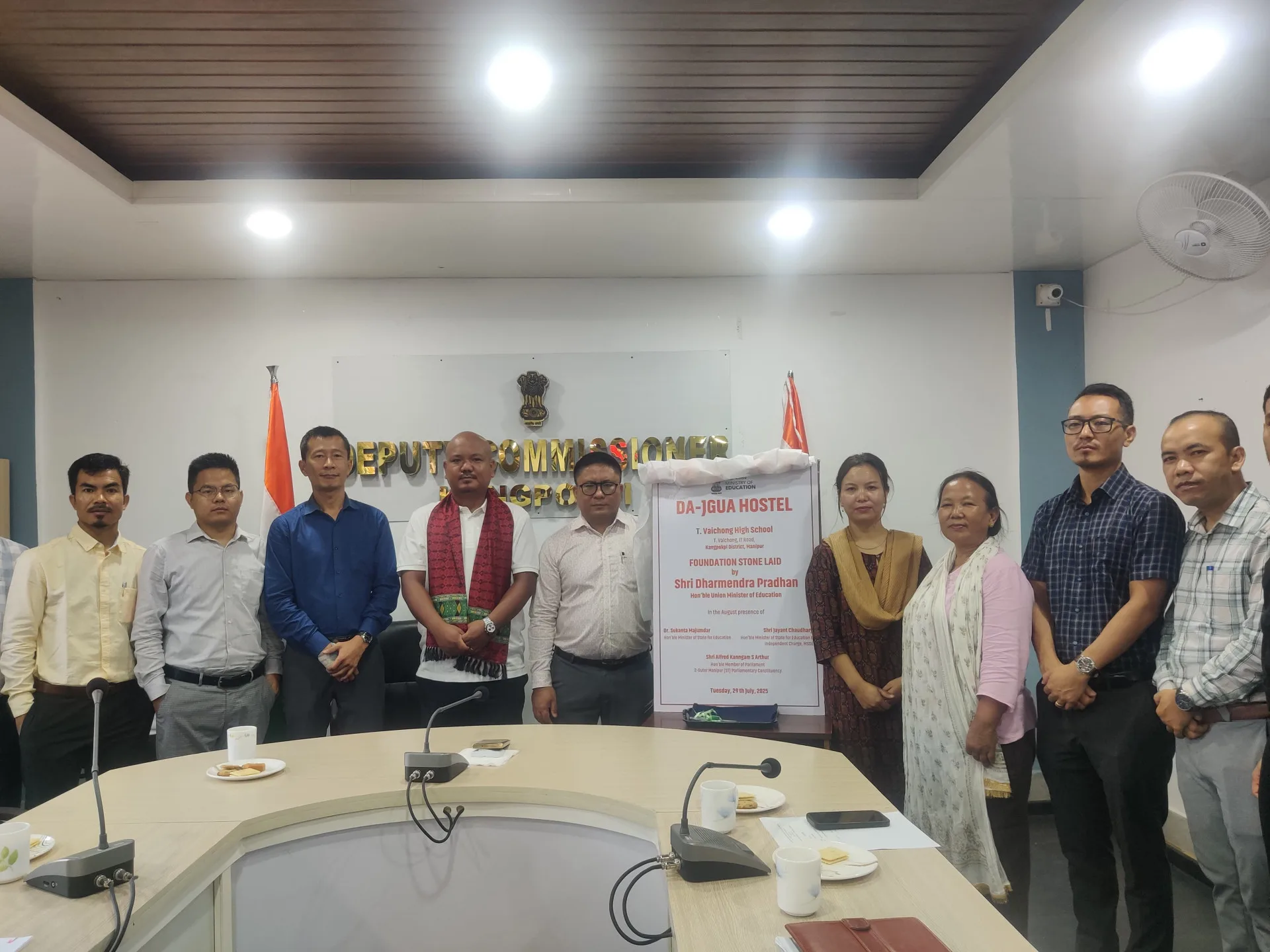
Kangpokpi, July 29: The foundation stone of the DA-JGUA Hostel for T Vaichong High School was virtually laid on Tuesday by Dr. Surkanta Majumdar, Hon’ble Union Minister of Education. The event, held in Kangpokpi District of Manipur, was part of the central government’s Dharti Aaba Janjatiya Gram Utkarsh Abhiyan (DA-JGUA) initiative, aimed at the holistic development of tribal communities.
The virtual ceremony was also graced by Jayant Chaudhary, Hon’ble Minister of State for Education (Independent Charge), and Alfred Kangam S Arthur, Hon’ble Member of Parliament representing 2–Manipur Outer. Their participation underscored the central government’s commitment to ensuring equitable access to education in remote tribal regions.
Welcoming the dignitaries, N. Shokhongam Baite (MCS), Additional Deputy Commissioner of Kangpokpi District, extended a warm greeting to the Chief of T Vaichong and other guests. In his remarks, the ADC highlighted the importance and long-term benefits of the hostel project, especially for students traveling from remote areas. He noted that the new hostel facility will help reduce school dropout rates significantly by addressing logistical challenges faced by students residing in distant villages within the constituency and district.
The ADC also took a moment to recognize and express heartfelt appreciation for the Chief of T Vaichong villages, Thangminlen Kipgen, who generously donated the land for the construction of the hostel. Praising this gesture, Baite emphasized the critical role of community leaders in promoting education and enabling a brighter future for the youth.
Also present at the event were several district-level officials, including Lamminlal Simte (MCS), SDO Champhai; Len Singsit (MCS), SDO Island; and Paotinsei Kipgen (MCS), SDO Saitu-Gamphazol, among others. Their presence signified the strong local administrative support for the DA-JGUA programme.
The Dharti Aaba Janjatiya Gram Utkarsh Abhiyan (DA-JGUA) is a flagship initiative of the Ministry of Tribal Affairs, Government of India, designed to bridge critical gaps in social infrastructure, health, education, and livelihoods in tribal regions. Implemented through convergence and outreach efforts of 17 line ministries, the programme aims to benefit over 5 crore tribal people across 549 districts and 2,911 blocks nationwide.
