

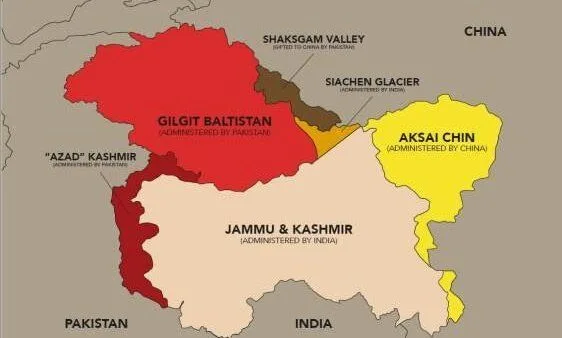
NEW DELHI, Jan 14: A fresh diplomatic spat has erupted between India and China after Beijing reaffirmed its territorial claims over the Shaksgam Valley, prompting a strong rebuttal from New Delhi which reiterated that the area is part of Indian territory.
China on Monday defended its infrastructure projects in the Shaksgam Valley, stating that such activities are being carried out within its own territory and are “beyond reproach.” The statement came in response to India’s recent objections to Chinese infrastructure development in the region.
India had last Friday criticised China’s projects in the Shaksgam Valley, asserting that it reserves the right to take all necessary measures to safeguard its interests, as the territory legally belongs to India.
Responding to the issue, External Affairs Ministry spokesperson Randhir Jaiswal said that India has never recognised the so-called China–Pakistan “boundary agreement” signed in 1963. “Shaksgam Valley is Indian territory. We have never recognised the so-called China-Pakistan boundary agreement signed in 1963. We have consistently maintained that the agreement is illegal and invalid,” Jaiswal said.
He also reiterated India’s long-standing position on the China-Pakistan Economic Corridor (CPEC), stating that New Delhi does not recognise the project as it passes through Indian territory under the forcible and illegal occupation of Pakistan.
Pakistan had illegally ceded 5,180 square kilometres of Indian territory in the Shaksgam Valley to China in 1963 from areas under its illegal occupation.
Reacting to India’s remarks, Chinese Foreign Ministry spokesperson Mao Ning said that the territory mentioned is part of China and that Chinese infrastructure activities there are legitimate. “China’s infrastructure activities in its own territory are beyond reproach,” she said at a media briefing in Beijing.
Mao further stated that China and Pakistan signed a border agreement in the 1960s to determine the boundary between the two countries, calling it a legitimate exercise of their rights as sovereign states. On India’s criticism of the CPEC, she reiterated Beijing’s stance that the project is an economic initiative aimed at promoting local development and improving livelihoods.
