

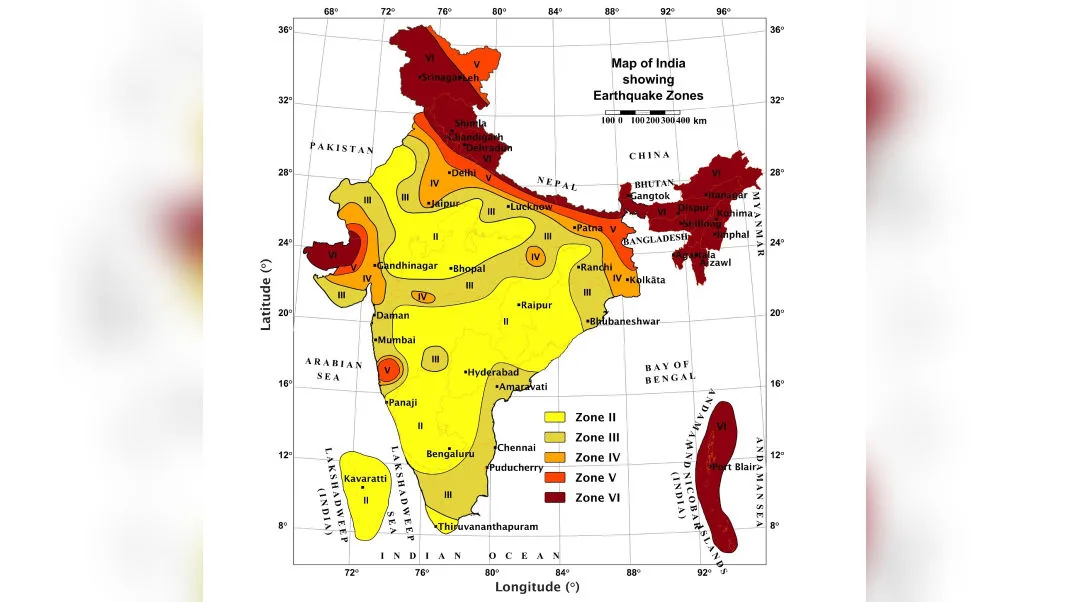
NEW DELHI, Dec 1: India has announced a sweeping upgrade to its national earthquake safety code, IS 1893:2025, unveiling a new five-zone seismic map that places 61% of the country’s land area—home to more than three-fourths of its population under moderate to high earthquake hazard.
The revised framework replaces the earlier four-zone system with Zones II, III, IV, V and the newly created highest-hazard Zone VI, marking the most significant overhaul of India’s seismic planning norms in nearly a decade. The new map has been released by the Bureau of Indian Standards (BIS).
According to officials, the update is based on an advanced Probabilistic Earthquake Hazard Assessment (PEHA) that integrates refined data on faults, tectonic features, expected earthquake magnitudes, and projected ground-shaking intensity. The assessment identifies Northeast India as one of the country’s most active seismic regions, placing the entire Northeast under Zone VI, the highest-risk category.
Beyond reclassification, the IS 1893:2025 code fundamentally modernizes India’s seismic design philosophy, transitioning from the older zone-factor method to a return-period-based probabilistic approach, in line with global best practices. The updated code also expands design criteria to include vertical ground shaking, soil flexibility, liquefaction potential, and strengthened safety provisions for architectural elements and utility systems—factors historically linked to casualties and infrastructure failures during major earthquakes.
Experts say the changes will have major implications for urban planning, infrastructure development and disaster preparedness, particularly in fast-expanding high-risk cities across the Northeast and Himalayan belt. BIS has reiterated that earthquake-resistant detailing remains mandatory for all structures in Zones III to VI, even in cases where other forces such as wind loads appear more dominant in design.
