

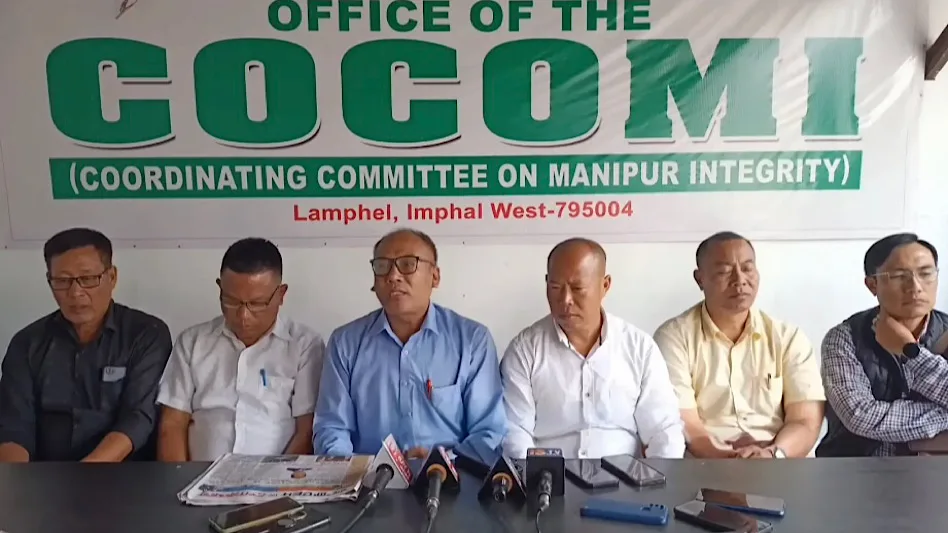
IMPHAL, Dec 3: The Coordinating Committee on Manipur Integrity (COCOMI) has strongly criticized the Indian government of its failure to safeguard Manipur’s territorial integrity. According to a press release on Tuesday, the committee claims that inaction and mismanagement have allowed ethnic rebel groups from Myanmar to exploit the state, exacerbating the ongoing crisis since the outbreak of what COCOMI terms “Kuki aggression” on May 3, 2023.
In its latest statement, COCOMI accused the government of compromising India’s sovereignty, citing evidence of infiltration, arms smuggling, and demographic changes that have destabilized the region. Former Governor of Manipur, Smt. Anusuiya Uikey, provided critical insights into the systemic failures fueling the unrest. In an interview with The Hindu on July 15, 2023, she remarked, “Infiltrators may have fueled the Manipur crisis.” She later told The Print on November 21, 2024, that, “There is an international hand behind the conflict, which is why violence can’t be stopped despite the Centre’s efforts. People of the state wanted the Prime Minister to visit. Despite repeated requests sent to the PMO, he has not visited.”
Adding weight to these concerns, Justice Siddharth Mridul, former Chief Justice of the Manipur High Court, stated in The Hindu on December 1, 2024, “The violence continues due to infiltration, smuggling of drugs and arms through Myanmar, and demographic changes over the years.” COCOMI emphasized that these admissions point to ineffective border management and a lack of decisive government action to address illegal activities that worsen the crisis.
The National Investigation Agency (NIA) has uncovered the involvement of Kuki militant groups such as the Kuki National Army (KNA), Kuki National Front (KNF), and United Kuki National Army (UKNA) in heinous crimes, including the murder of four civilians in January 2024, as reported by E-Pao.net on December 2, 2024. Despite these findings, COCOMI claims the government has failed to dismantle these groups’ infrastructure or hold them accountable.
Reports from border villages, highlighted in Ukhrul Times on May 18, 2024, detail how Kuki militants operate freely across the India-Myanmar border, receiving logistical support and arms. Allegations of inaction, and even collusion, by Indian security forces such as the Assam Rifles have further fueled public outcry. An Indian Army officer, speaking to the media, reportedly said, “KVA or KNA (B) are the same. On the Myanmar side, they are known as KNA (B), and just a change of nomenclature when they cross the border.” COCOMI has expressed alarm over this tacit acknowledgment of cross-border militant activity and its implications for national security.
Before the conflict escalated in 2023, a Cabinet Sub-Committee on Illegal Immigration, led by Minister Letpao Haokip, identified 2,480 illegal immigrants across multiple districts in Manipur. However, the campaign was abruptly stopped following the outbreak of violence in May 2023, leaving thousands of illegal settlers unaccounted for. According to Economic Times on May 12, 2024, this inaction has only deepened the crisis, allowing illegal settlers to further destabilize the region.
COCOMI has labeled the situation as “Kuki Aggression under the Disguise of India’s Proxy War,” accusing the government of deliberate inaction and framing the crisis as a mere ethnic or communal conflict. This misrepresentation, according to the organization, has absolved the government of its responsibility to address the root causes of violence while worsening the suffering of indigenous communities.
In a strongly worded appeal, COCOMI demanded that the government acknowledge the ongoing crisis as a “proxy war” involving external actors and state negligence. They urged the government to take immediate action to secure the India-Myanmar border, dismantle militant networks, and address the demographic imbalance caused by illegal immigration.
COCOMI’s statement concluded with a call to action, “COCOMI appeals to every Manipuri and like minded citizens of INDIA to reject misleading narratives and recognize the crisis of what it truly is a deliberate compromise of Manipur’s territorial and demographic security by the government of India’.
