

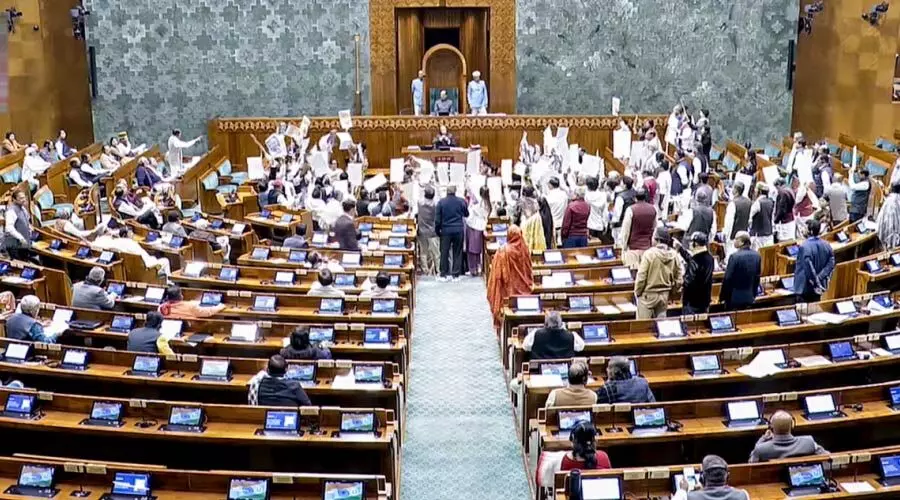
NEW DELHI, Dec 16: The Lok Sabha on Tuesday witnessed sharp confrontations as the Viksit Bharat Guarantee for Rozgar and Ajeevika Mission (Gramin) (VB-G RAM G) Bill, 2025, was introduced to replace the Mahatma Gandhi National Rural Employment Guarantee Act (MGNREGA), triggering strong opposition protests over the omission of Mahatma Gandhi’s name from the new legislation.
Introducing the Bill, Union Rural Development Minister Shivraj Singh Chouhan said the Narendra Modi government not only believes in Mahatma Gandhi but also follows his principles, asserting that the Centre has done more for rural development than previous governments. The proposed law seeks to provide a statutory guarantee of 125 days of wage employment annually to rural households, compared to 100 days under MGNREGA.
Opposition parties, however, objected to the Bill at the introduction stage and demanded that it be referred to a parliamentary standing committee for detailed scrutiny. Congress leaders, including Priyanka Gandhi Vadra, criticised the government for what they termed an “obsession” with renaming schemes and erasing Gandhi’s legacy.
Congress MP Shashi Tharoor launched a scathing attack on the BJP-led Centre during the debate, mocking the move by quoting a popular 1971 Bollywood song — “Ram ka naam badnaam na karo”. He described the Bill as a “deeply regrettable and retrograde step” that undermines the philosophical foundation of rural employment guarantees. Tharoor also raised concerns over the proposed financial restructuring, particularly the requirement for states to bear 40 per cent of the scheme’s cost, warning that it could make the programme unviable.
As protests intensified, opposition MPs, holding photographs of Mahatma Gandhi, entered the Well of the House to express their disapproval of removing the Father of the Nation’s name from the legislation, even as proceedings continued under disruptions.
According to the government, the VB-G RAM G Bill is aligned with the vision of “Viksit Bharat 2047” and aims to create employment while building durable rural infrastructure. The Bill focuses on four priority areas — water security, core rural infrastructure, livelihood-related assets, and works to mitigate extreme weather events. States will be required to frame their own schemes in line with the new law within six months of its enactment.
