

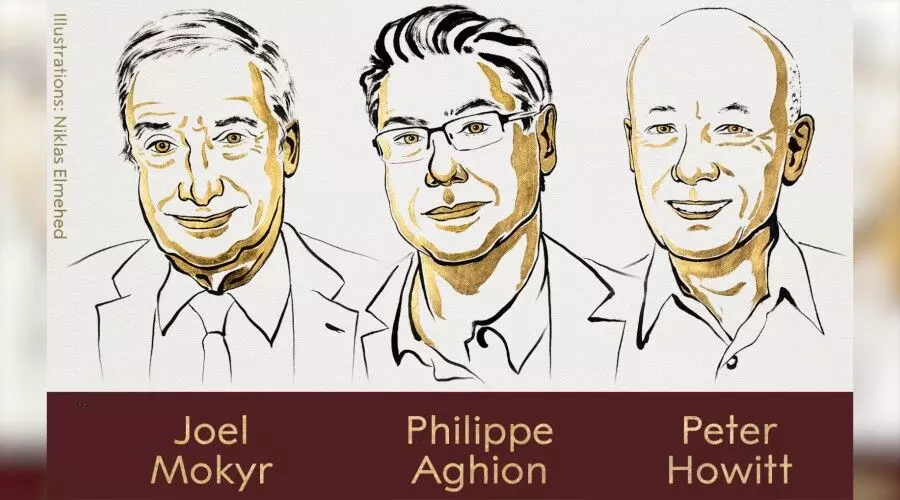
Stockholm, October 13: The 2025 Nobel Prize in Economic Sciences has been awarded to Joel Mokyr (Northwestern University, USA), Philippe Aghion (Collège de France and INSEAD, Paris), and Peter Howitt (Brown University, USA) for their pioneering work explaining how innovation fuels technological progress and sustained economic growth.
The Royal Swedish Academy of Sciences announced that Mokyr received half of the prize “for identifying the prerequisites for sustained growth through technological progress,” while Aghion and Howitt shared the other half “for the theory of sustained growth through creative destruction.”
According to the Academy, their groundbreaking research illuminates how innovation has been the driving force behind the unprecedented global economic expansion witnessed over the past two centuries. “This year’s laureates explain how innovation provides the impetus for further progress,” the statement said.
Mokyr’s work blends economic theory with historical research, revealing that scientific understanding — not just practical know-how — is essential for continuous innovation. He emphasized that societies open to new ideas and intellectual exchange were more likely to experience enduring economic growth.
Meanwhile, Aghion and Howitt’s landmark 1992 model of “creative destruction” demonstrated how new innovations replace outdated technologies and firms, propelling growth while simultaneously creating resistance from established industries. The Academy noted that effectively managing these conflicts is key to sustaining progress.
John Hassler, Chair of the Committee for the Prize in Economic Sciences, remarked, “The laureates’ work shows that economic growth cannot be taken for granted. We must preserve the mechanisms that drive creative destruction to avoid stagnation.”
Last year’s Nobel in Economics was awarded to Daron Acemoglu, Simon Johnson, and James A. Robinson for their research on how institutions shape prosperity and global wealth disparities.
