
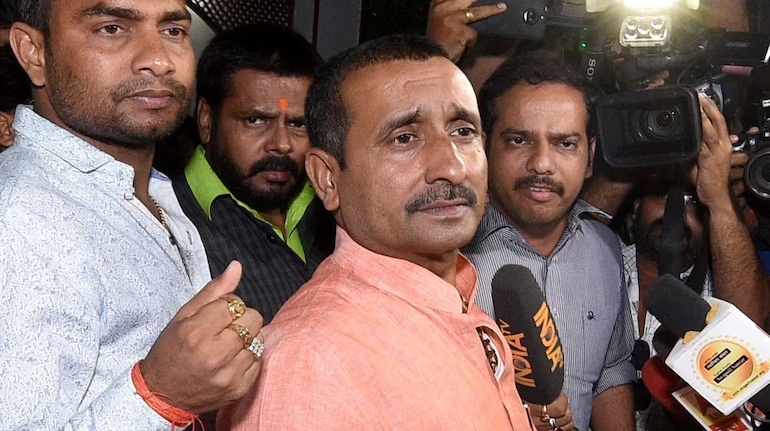
NEW DELHI, Dec 29: The Supreme Court on Monday stayed the operation of a Delhi High Court order that had suspended the life sentence of expelled BJP leader and former Uttar Pradesh MLA Kuldeep Singh Sengar in the 2017 Unnao rape case, directing that he shall not be released from custody.
A three-judge vacation bench comprising Chief Justice Surya Kant and Justices J.K. Maheshwari and Augustine George Masih passed the interim order while hearing a petition filed by the Central Bureau of Investigation (CBI) challenging the High Court’s December 23 decision. The apex court also issued notice to Sengar, seeking his response within four weeks, and posted the matter for further hearing thereafter.
Clarifying its order, the Supreme Court said that despite the suspension of sentence by the High Court, Sengar would continue to remain in jail. The bench observed that although courts generally refrain from staying orders where a convict has already been released, the present case involved “peculiar facts”, as Sengar is also serving a 10-year sentence in the custodial death case of the rape survivor’s father.
Appearing for the CBI, Solicitor General Tushar Mehta urged the court to stay the High Court’s order, describing the case as a “horrific case of rape of a child”. He submitted that the survivor was 15 years old at the time of the offence and that Sengar had been convicted under both the Indian Penal Code and the Protection of Children from Sexual Offences (POCSO) Act. Mehta argued that the High Court failed to adequately consider the IPC conviction while suspending the life sentence and cautioned that Sengar’s release could pose a serious threat to the survivor and her family.
The Delhi High Court had suspended Sengar’s sentence of imprisonment for the remainder of his natural life, noting that he had already spent over seven years and five months in custody. The suspension was granted during the pendency of his appeal against a December 2019 trial court verdict. The High Court had taken a prima facie view that the charge of aggravated penetrative sexual assault under the POCSO Act was not made out, holding that Sengar could not be treated as a “public servant” or as a person in a “position of trust or authority” under the relevant provisions.
The Supreme Court noted that the case raised substantial questions of law that required detailed examination. During the hearing, the bench remarked on the apparent inconsistency in excluding an elected MLA from the definition of a public servant while including other public officials under the statute.
Senior advocates appearing for Sengar opposed the CBI’s plea, contending that an MLA does not fall within the definition of a public servant under the POCSO Act and that penal statutes must be strictly interpreted.
The Unnao rape case and related proceedings were transferred from Uttar Pradesh to Delhi in August 2019 on the directions of the Supreme Court.
