
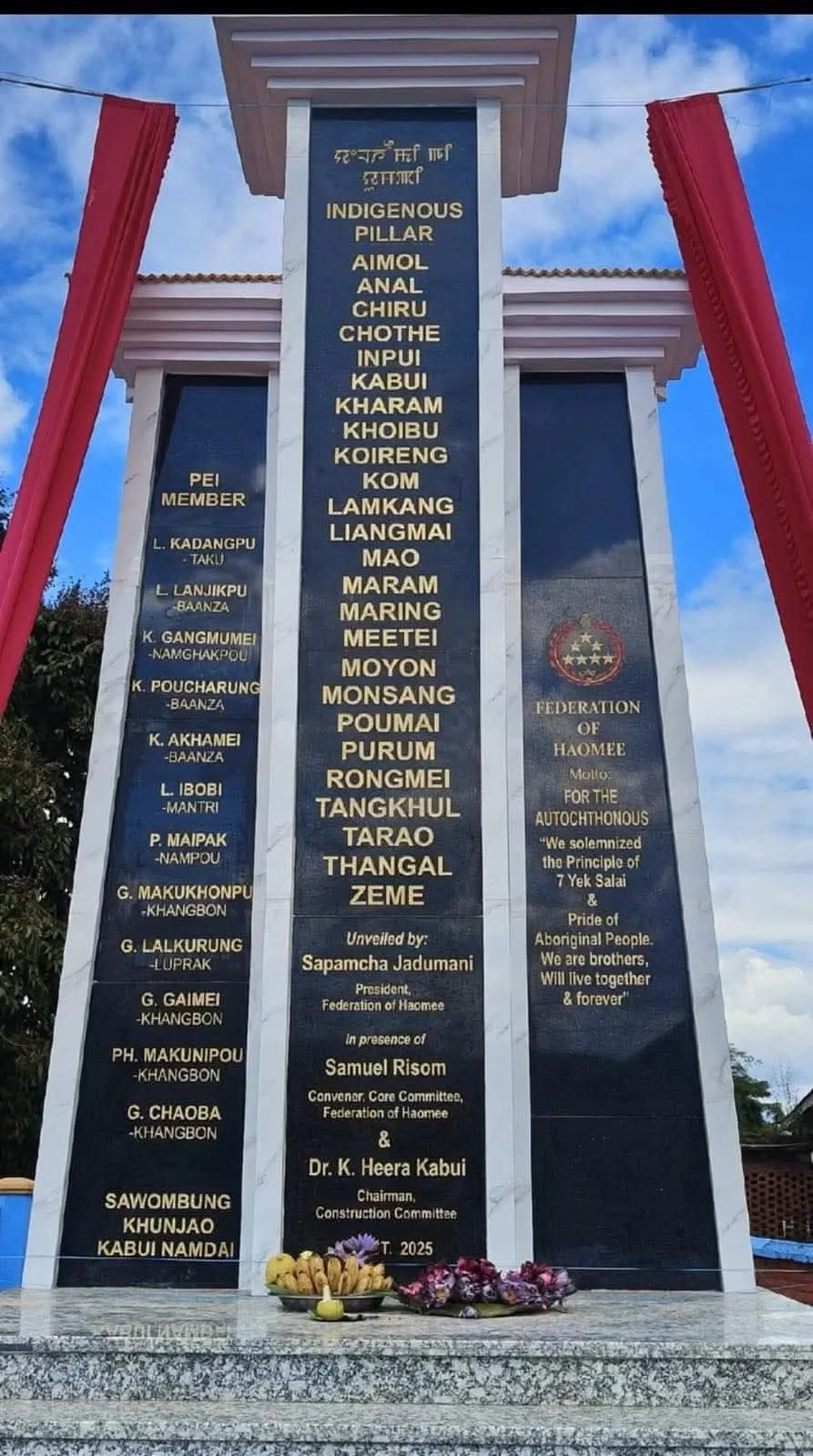
Imphal, October 13: The Thadou Students’ Association (TSA) has issued a clarification regarding the Indigenous Pillar recently unveiled by the Federation of Haomee (FoH) at Sawombung Kabui Khunjao, Imphal East, on October 6. The statement comes amid concerns over the representation of indigenous communities in the state.
According to the TSA, under The Manipur Inner Line Permit (ILP) (Amendment) Rules, 2022 and the Bengal Eastern Frontier Regulation (BEFR), 1873, extended to Manipur in 2019, the State government officially recognizes three categories of indigenous persons: Meitei or Meetei, Meitei-Pangal (Manipuri Muslims), and the recognized Scheduled Tribes, comprising 33 tribes as notified under Article 342(1) of the Constitution of India. “All these groups, including the Thadou community, are legally recognized as indigenous persons of Manipur, provided they resided in the State on or before 31 December 1961,” the TSA noted.
While acknowledging the FoH’s intent to preserve the Yek Salai system and promote cultural unity, the TSA clarified that the list of 25 communities engraved on the Indigenous Pillar and their seven Salais representation is not a government-authorized or legally defined classification of indigenous persons in Manipur. “Of these, 24 communities are already notified as Scheduled Tribe Category, all identifying with the broader Naga ethnic family. The Meitei community, represented by FoH President Sapamcha Jadumani and others, may express its cultural solidarity through such initiatives, but it does not represent all Meiteis or the full indigenous diversity of Manipur,” the TSA statement read.
The TSA further emphasized that the eleven non-Naga Scheduled Tribes, including Thadou, Hmar, Mizo, Zomi, and others, though not represented in the Yek Salai system or seven-coloured flag, are equally recognized by the Government as indigenous persons. “Their exclusion from the FoH’s pillar should not be viewed as marginalization but as a cultural expression limited to certain communities alone,” TSA said.
The statement urged the Federation of Haomee to avoid promoting the notion that only the 25 listed communities constitute the indigenous peoples of Manipur. “The FoH represents these 25 communities collectively and is not an exclusively Meitei civil society organization. Therefore, any statements or interpretations that could provoke tension or create misunderstanding among indigenous groups should be avoided in the interest of unity and mutual respect. Such views, if any, should not be construed as the collective perspective of the community as a whole,” TSA added.
Reaffirming its commitment to peace and unity, the TSA highlighted a community understanding reached on 6 August 2025 between the Thadou community and major Manipur civil society organizations, including COCOMI, AMUCO, FOCS, and AT. “This agreement pledged to protect Manipur’s territorial integrity and promote peaceful coexistence among all communities. It represents a broader and more inclusive mandate than any single organizational initiative like FoH,” the TSA stated.
The TSA concluded by urging Thadou individuals and the public not to be misled by misinformation that could create divisions. “The Indigenous Pillar erected by the Federation of Haomee should not be seen as an exclusionary act against any tribe but as a specific cultural commemoration by certain groups or an NGO. We call upon all indigenous communities to continue working together for peace, development, mutual respect, and harmonious coexistence in Manipur,” the statement said.
